Evaluating Watercolor Testy Sandwich Clipart for Creative and Commercial Projects
In the expansive world of digital design resources, food-themed illustrations occupy a unique niche that bridges culinary appeal with artistic expression. Among these, Watercolor Testy Sandwich Clipart has emerged as a distinct category for creators seeking a balance between realism and hand-painted charm. This specific style of digital asset moves beyond simple vector icons or flat photography, offering a textured, organic aesthetic that resonates well with audiences looking for warmth and authenticity in visual content. For designers, crafters, and print-on-demand entrepreneurs, understanding the nuances of this medium is essential when selecting the right graphics for a project.
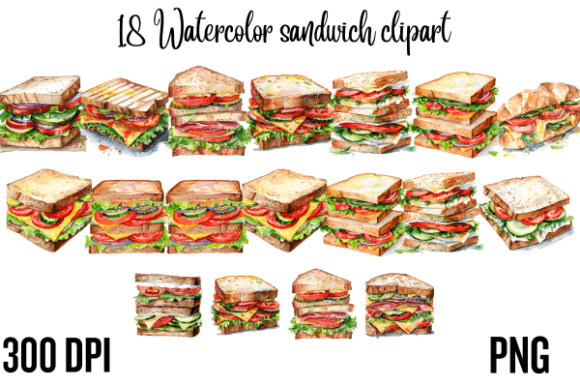
The term "testy" in this context often serves as a playful variation of "tasty," implying a sandwich that is not only appetizing but bursting with character. These illustrations typically feature high-resolution depictions of layered ingredients—lettuce, tomatoes, cheeses, and various meats—rendered with the fluidity and transparency characteristic of watercolor painting. When evaluating a bundle of such assets, such as a collection of 18 PNG files with 3000px by 3000px dimensions at 300 DPI, one must consider how these technical specifications translate into practical utility across different mediums.
Distinguishing Watercolor Styles from Other Digital Formats
To make an informed decision about incorporating Watercolor Testy Sandwich Clipart into your workflow, it is helpful to compare it against other prevalent styles in the food illustration market. The primary alternative is usually vector-based clipart or high-resolution stock photography. Each approach offers different strengths and limitations depending on the intended application.
Vector graphics are defined by mathematical paths, allowing for infinite scalability without loss of quality. They are ideal for large-format signage or logos where crisp, solid lines are required. However, vectors often lack the textural depth and organic imperfections that make watercolor art feel inviting. A vector sandwich might look clean and precise, but it can sometimes appear sterile or overly commercial. In contrast, watercolor clipart captures the subtle bleeding of colors, the grain of the paper, and the soft edges that mimic traditional painting. This makes Watercolor Testy Sandwich Clipart particularly effective for projects aiming to evoke a homemade, artisanal, or rustic vibe.
On the other end of the spectrum is stock photography. While photos offer ultimate realism, they come with lighting constraints and background limitations. Removing a sandwich from its photographic background can result in unnatural edges or halos, making integration into new designs challenging. Watercolor illustrations, especially those provided as transparent PNGs, are pre-isolated from their backgrounds. This allows for seamless layering onto colored papers, patterns, or product mockups without the need for complex masking or editing. The artistic interpretation inherent in watercolor also allows for a level of stylization that photography cannot achieve, enabling designers to create a cohesive brand identity that feels curated rather than captured.
Technical Specifications and Their Impact on Usability
When reviewing a digital download bundle, the technical metrics are just as critical as the artistic style. A standard offering for high-quality sublimation and print-on-demand work includes files at 300 DPI (dots per inch) with dimensions around 3000px by 3000px. Understanding why these numbers matter is key to evaluating the value of a Watercolor Testy Sandwich Clipart collection.
The 300 DPI resolution is the industry standard for professional printing. It ensures that when the image is transferred onto physical substrates like ceramic mugs, canvas tote bags, or t-shirts, the output remains sharp and detailed. Lower resolution files (such as 72 DPI, common for web use) will appear pixelated or blurry when printed, ruining the delicate brushstrokes that define the watercolor aesthetic. Similarly, the pixel dimensions determine the maximum print size. A 3000px image at 300 DPI allows for a print area of approximately 10 inches by 10 inches. This is sufficient for most apparel designs, mug wraps, and sticker prints. If a project requires a massive wall mural, these dimensions might be a limitation, necessitating a vector alternative or a specialized high-res commission.
Furthermore, the file format plays a crucial role. PNG files with transparency are indispensable for sublimation and digital crafting. Unlike JPEGs, which include a white background box, transparent PNGs allow the watercolor sandwich to float freely on any background color or pattern. This flexibility is vital for users creating birthday stickers, planner decorations, or custom packaging where the design must adapt to various base colors.
Ideal Use Cases and Application Scenarios
The versatility of Watercolor Testy Sandwich Clipart makes it suitable for a wide array of applications, particularly those targeting a demographic that appreciates food culture and handmade aesthetics. One prominent use case is in the realm of sublimation printing. The vibrant yet soft tones of watercolor translate beautifully onto polyester-coated items. Designs featuring these sandwiches can be applied to lunch boxes, kitchen aprons, and cafe menus, reinforcing a theme of fresh, gourmet dining.
In the sphere of digital planning and scrapbooking, these assets serve as decorative elements that add personality to layouts. A bundle containing varied angles and ingredient combinations allows users to construct custom scenes, such as a picnic spread or a brunch table setting. The "gastronomic adventure" aspect of the art encourages storytelling within the design, making it more engaging than a generic icon.
Additionally, these illustrations are highly effective for small business branding. A bakery, deli, or food truck looking to establish a friendly, approachable image might find that watercolor art aligns better with their brand voice than stark modern minimalism. The hand-painted look suggests care and craftsmanship, qualities that consumers often associate with high-quality food products. Whether used on business cards, social media graphics, or packaging labels, the art helps convey a narrative of freshness and flavor.
Limitations and Decision Factors
While Watercolor Testy Sandwich Clipart offers significant aesthetic benefits, it is not the universal solution for every design challenge. Designers must weigh certain tradeoffs before committing to this style. The primary limitation lies in editability. Unlike vector files, where individual components (like a slice of tomato or a piece of lettuce) can be easily moved, recolored, or reshaped, raster-based watercolor PNGs are flattened images. If a client requests a specific change to the ingredient arrangement or color palette, the designer is limited to what the original file provides. This lack of modularity means that buyers must carefully review the variety within a bundle to ensure it meets their specific needs.
Another consideration is the complexity of the background. While watercolor art is generally clean, some illustrations may include subtle washes or splatters that are part of the artistic intent. When placing these on very light or white backgrounds, these artistic flourishes usually enhance the look. However, if the final product requires a strictly solid color fill behind the subject, additional editing in software like Photoshop may be required to clean up the edges or remove unwanted texture.
Furthermore, the subjective nature of "tasty" or "appetizing" means that style preferences vary. What one viewer finds charmingly rustic, another might perceive as messy or indistinct. It is important for buyers to examine the level of detail in the preview images. High-quality watercolor clipart should clearly distinguish between ingredients—showing the difference between ham and turkey, or cheddar and swiss—without the colors blending into an unrecognizable mud. If the resolution or painting technique obscures these details, the image may fail to communicate the intended message of freshness.
Making the Right Choice for Your Project
Ultimately, the decision to utilize Watercolor Testy Sandwich Clipart depends on the specific goals of your project and the audience you aim to reach. If your objective is to create a warm, inviting atmosphere that celebrates the art of food preparation, this style is likely superior to cold, geometric vectors or impersonal stock photos. It excels in contexts where emotion and sensory appeal are paramount, such as birthday invitations, culinary blogs, and boutique product packaging.
However, if your project demands strict brand guideline adherence, infinite scalability, or the ability to deconstruct and rearrange elements dynamically, a vector-based solution might be more appropriate. Similarly, for ultra-realistic advertising campaigns where the exact appearance of the food is legally or marketing-critical, professional photography remains the gold standard.
For those operating in the print-on-demand space, the balance offered by high-resolution watercolor bundles often tips the scale in their favor. The combination of artistic flair, ease of use via transparent backgrounds, and sufficient resolution for standard merchandise makes these assets a practical and efficient resource. By understanding the distinct characteristics, technical requirements, and ideal applications of these illustrations, creators can confidently select the tools that best enhance their visual storytelling and meet their commercial objectives.